Showing posts with label Motorsports. Show all posts

Saturday, September 15, 2012

Hyundai Genesis Coupe: A Lesson in Frugality for the Sports Segment


While the auto industry was cracking under economic pressures in 2008 and sales were down most auto makers were feeling the heat. But while others were scrambling to make their cars more affordable, sporty, refined, and generally as appealing as they could, Hyundai sat back and enjoyed the fruits of its labour. Global sales may have been down by 15.1%, but you’d never guess if you only looked at Hyundai whose sales actually increased by 25.3% in the first quarter of ’09. And all in one sudden flash it became clear that they were no longer the strange, cheap foreign car manufacturer that we’d remembered. Hyundai alone seemed to be gaining valuable ground on the economic front and began muscling into Honda and Toyota’s territory as they accounted for 7.1% of Canadian light vehicle sales in ‘09, 10% if you count its sister company Kia. All this success can be traced back to just one element: the cars. Hyundai was snatching up all the sales coming from the boom in the compact market by offering cheap, efficient, and reliable compacts and sub-compacts like the Elantra and Accent.

And one good turn deserves another as Hyundai broadened its line up in 2008 to include an entry level luxury sedan called the Genesis, which offered something that no one had anticipated in a entry level luxury coming from an economy company, Rear Wheel Drive. The Genesis met with instant success and earned AJAC’s best new luxury car under 50k, Canadian Car of theYear, North American Car of the Year, and Consumer Reports Top Rated Upscale Sedan. Hyundai was on a roll and quickly solidified a reputation for producing high quality vehicles in just about every segment of the market.

2009 Canadian Car of the Year: The Hyundai Genesis Sedan

With the inspiring success of the Genesis, Hyundai decided to make the hit a one-two punch by adding a variant of the luxury sedan to the market that would cause a completely new stir. Making its debut at the 2008 New York International Auto Show, Hyundai planned to release the Genesis Coupe for the 2010 model year in North America. Hyundai claimed its Coupe was a proper Rear Wheel Drive sports car that would compete with the likes of the RX-8, Infinity G37, and even the BMW 3-Series, and although it realistically competed with the Nissan Altima Coupe, Honda Accord Coupe, Civic Si, and Cobalt SS, the Genesis Coupe was no doubt a fierce competitor that went into the ring radiating passion and breathing fire.

A rally version of the Genesis Coupe

The Coupe gained valuable publicity from an ad campaign that allowed individuals to edit footage from a project called “epic lap” in which professional stunt driver and drift champ Rhys Millen passionately lapped a course in the Coupe, and post it to edityourown.com. The best edited version of the epic lap would be shown during the Super Bowl and the editor would receive both a cash prize and their own Genesis Coupe. Since then, the Coupe has appeared on TV in series like Leverage, Burn Notice, and 24.


Meant to be a balance of “Brain and Brawn” as Hyundai puts it, the Genesis Coupe offers a 55/45 weight distribution for more neutral handling on the track, RWD for tossability in the corners, and a variety of engines for versatility in real world driving conditions. The base 2.0L four cylinder is turbo charged and good for 210 horses and 223lb. ft at only 2000rpm that clocks a 0-100km/h time of just 8.3 seconds! The turbo charger is sourced from Mitsubishi, resembling the turbo installed in the Evo X, and provides a smooth charge throughout the powerband. Because power starts at just 2000rpm and hp is maxed out at 6000rpm the power band is rather large in the 2.0T base model. The optional 3.8L naturally aspirated Lambda V6 is sourced from the Genesis sedan and is a step up with 306hp and 266lb. ft. which improve 0-100 time to just over 6 seconds!


The engine turns over at a higher than average rate for highway driving at 2600rpm for 100km/h, although a wider ratio would improve the already adequate 10.1/6.6 city/hwy mileage, its closer than average transmission can also be a boon on the track where torque can be capitalized on in various situations and at higher speeds. Still, the engine can drink both regular unleaded and high octane for added versatility, and the low end torque also means driving in high gear for improved efficiency is a breeze.  Both engines come standard with a 6 speed manual transmission and optional with a 6 speed automatic for an extra $1800 on 3.8s and a 5 speed automatic for $1500 on turbos. Both automatic transmissions come with SHIFTRONIC paddle-shifters that shift quickly and smoothly as far as paddle shifters usually go, and although ST usually discourages automatics, these transmissions might be best for those that have trouble shifting quickly while keeping their focus on the track during a race.


Genesis Coupe with Automatic Transmission and Paddle shifters

Standard features abound on the Genesis Coupe and there’s slight refinement inherited from the Genesis Sedan in the Standard conveniences like A/C, trip computer, Bluetooth with steering mounted controls alongside audio and cruise controls, an iPod input jack located in the centre storage bin, leather wrapped steering wheel and shifter, keyless entry, power locks, windows, and power heated mirrors. And of course standard equipment only gets better if you buy the GT trim which adds 19” alloys, 6.5” touch nav system, Automatic climate control, heated leather seats, 360watt Infinity/AM/FM/XM/CD/MP3 10 speaker audio system with a CD changer, a 3 month subscription to XM satellite radio, push button start, HID and auto-leveling headlights, mirror integrated turn signals, and tilt/slide sunroof.
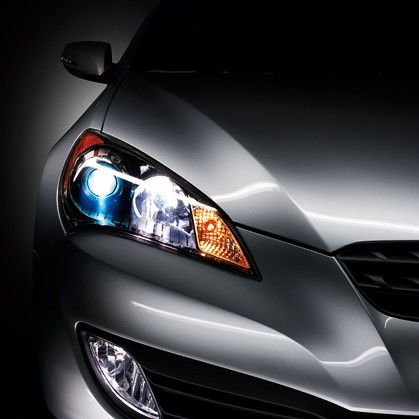
Complimenting all the conveniences are excellent safety features like advanced front, front seat mounted side, and roof mounted curtain airbags, three point pretensioned seat belts, front active head restraints, fog lights, ABS, EBD, ESC and Traction control. The stability and traction controls are especially useful as they help tame the oversteer and traction loss often found in RWD coupes. Also, the auto-leveling headlights are almost as good as adaptive headlights when it comes to keeping the road visible despite bumps or twists. Of course, while riding in the nearly unusable rear seats is both an ergonomic hazard as well as a safety risk, when it comes to peace of mind while driving all that power, the Genesis Coupe doesn’t settle for anything less than its competitors in the front seats.


On the outside Hyundai impresses us by hitting a home run on the first pitch with their Coupe’s styling. The exterior is remarkably handsome for a first attempt at a sports coupe. It has a unique blend of shapes and designs that grab attention with some authority. Staggered standard 18” alloys and optional 19” alloys have an attractive 10 spoke design that compliments the sharp headlights, taillights, and fog lights, and together they give the Coupe an aggressive stance that is fitting for a sports car. The longitudinal mounted engine lengthens the hood’s graceful curves down to the petit front grille that surprisingly doesn’t look out of place in the least. Still there is a lingering notion that the best years for the Genesis coupe’s styling are yet to come. But for the moment, the overall design has great continuity and a unique harmony that is well thought out, and is, dare I say, cool?


From bumper to bumper the Genesis Coupe looks like a true sports coupe


The interior is classic sports coupe; racing inspired, driver oriented with pretty decent front seats and unusable rear seats. But who really cares about the rear seats in a car like this? The front seats are comfortable enough with both manual height and lumbar support adjusters on the driver’s seat and fore and aft adjustable headrests for longer trips on both driver and passenger seats. Visibility is great out of the front and even out of the side windows thanks to a dropped down beltline on the rear side windows that keep the blind spots to a minimum. However, the view out the back is partially obstructed by the high trunk and further spoiled by the trunk lip spoiler. A few things that will bother most buyers are the fact that the steering wheel only tilts and doesn’t telescope, which is strange considering its importance on a sports car, and space is cramped around the center console. As a matter of fact, elbows are bound to hit the center storage bin during shifts.

Although the Genesis Coupe and Sedan share the same first name, a decision that will no doubt confuse many, they are nearly incomparable. One of the most important areas where the Genesis Coupe separates itself from its luxury sedan cousin is in its interior quality. Ergonomics SUCK! The engine and road noise is above average, and although it isn’t loud enough to prompt impulsive use of the 360watt sound system it does need more sound insulation. Furthermore, the center armrest is hard, the door panel armrest is hard, and even the dash is hard. But the most outstanding fouls are the power window, lock, and mirror controls which are mounted to the door in a way that suggests the designer only cared about a racy feel and just stuck them on because they had to go somewhere. Operating any of them is awkward at the least. Still, most won’t buy this car for a plush ride and any hint at the Genesis Sedan’s luxury is misleading.

Similarly, the Genesis Coupe isn’t practical. The trunk only holds 332L of cargo and despite being able to store longer items by folding the rear seats, in order to stow anything substantial like a pair of skis one would either need to move the front passenger seat forward, or fold it down as well. Moreover, the rear seats are only good for throwing jackets or other junk on; shame on anyone that subjects their friends to a ride in them. But, again, no one is going to buy this car because they think it’s practical.

On the track the 2.0L turbo is impressive and offered a better weight balance that resulted in more control through corners and better lap times, but the 3.8L was far from clumsy. Granted one might be tempted by the 3.8L optional engine because of its significantly better acceleration, it might not be worth the cost considering the more than adequate power of the standard turbo charged 2.0. Whichever engine you decide on, if handling is a priority the optional GT suspension package should be on your list. Although the standard setup of MacPherson front struts, and a 5-link independent rear suspension is alright, the GT trim gets you a front strut tower brace, larger front and rear stabilizer bars, stiffer springs, larger bushings, a Torsen LSD, and a Brembo brake system which take the Genesis’ agile nature to a new level. The Brembo brake system is pretty impressive and adds Bridgestone Potenza P225/40VR19 front/ P245/40VR19 rear tires, 13.4/13.0 front/rear ventilated rotors and four-piston monobloc fixed callipers. Actually, considering that the Brembo system costs more if bought aftermarket than the entire GT package, the GT package is a frugal choice for enthusiasts. Still, the ride is punishing on broken or rough pavement, and if you’re looking for a comfortable ride don't even try the Coupe.

Hyundai is one of the best in the business when it comes to warranties, and they make no exceptions for their new sports car. The Genesis Coupe comes with Hyundai’s standard 5 year/100,000km bumper to bumper warranty, which means you can drive this sports coupe carefree for 5 whole years. This already stellar warranty can be lengthened to a whooping 8 years/160,000km for just $2,200! If you’re thinking what we’re thinking, you could sell the Coupe after a few years of fun for better than average market value because it would still be under warranty, that is if you ever plan to sell it.

Oh, but we’ve saved the best for last. Hyundai has pulled off a feat of frugality the likes of which never graced the RWD sport segment until now. The base model Genesis Coupe 2.0T will only cost you $24,495. Although the Coupe is just as good as its competitors and doesn’t really need to undercut them, it does it anyway. And it’s not just sitting at a fairly cheap price; it sincerely takes its competition to the cleaners, everyone one of them, from the Mazda RX-8 ($41,995) and Nissan Maxima ($37,880), to modestly priced FFs like the Honda Accord Coupe ($26,790) and even the Honda Civic Si ($25,990)! By offering a RWD turbo charged sport coupe that costs less than a sporty FWD Honda Civic Hyundai has set the value for money bar even higher, and that’s saying a lot considering they are already market leaders in value for money.

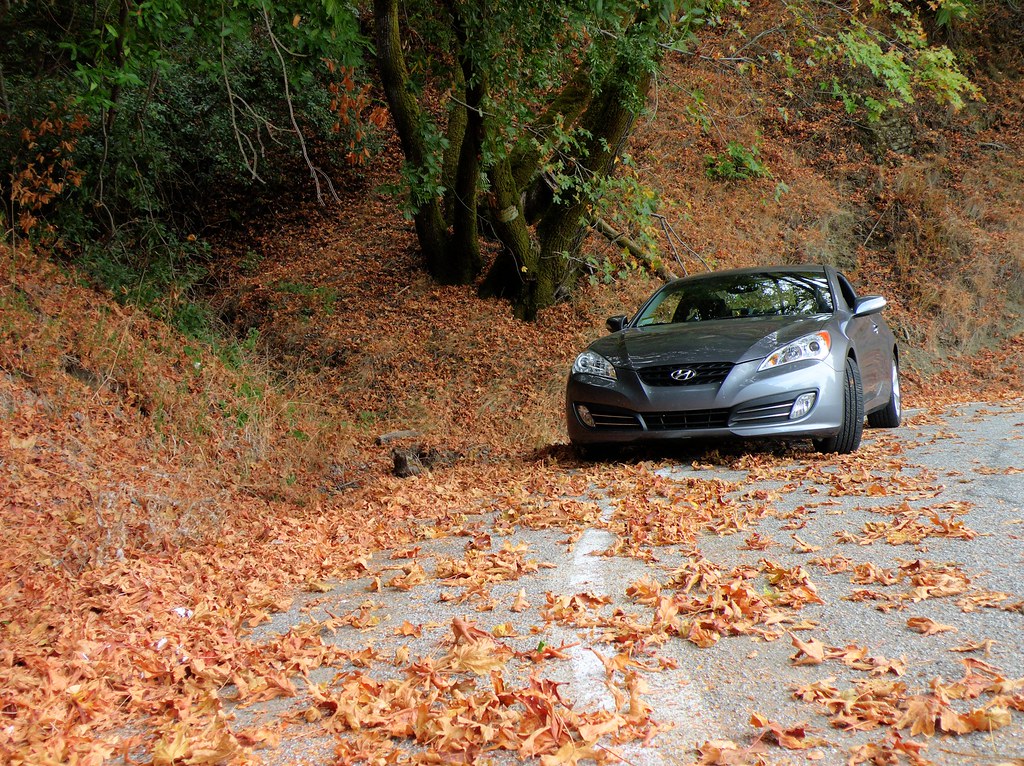


Accordingly, the Genesis Coupe is an impressive first attempt at a sports coupe from Hyundai. The styling is unique and attractive, the engine has enough power to dish out an adrenaline rush and the handling and braking are phenomenal. With pricing sitting just below $25,000 the Genesis Coupe gives buyers some serious incentive to choose Hyundai over other makers. The Genesis Coupe is a purpose built sports car with some serious appeal and performance to match, just don't expect any of the Genesis Sedan's luxury or comfort and you'll be one happy driver.

Saturday, August 11, 2012

Mini Cooper: Jack of All Trades, Master of Fun


You might be interested in this article if...
-         You’re a sports car enthusiast that isn’t allowed a sports car because it isn’t practical
-         You have had one of the original Austin Mini’s in your driveway
-         You want to buy something unique that will get you a lot of attention


There aren’t many sports cars on the market that a man with a family can justify buying. Unless you’ve got the cash for a second car, most are out of luck and can only dream of a thrilling or flashy ride while driving a utilitarian minivan. However, there are a few exceptions, the MINI Cooper is one of them.

Initially created under the Austin MINI nameplate in anticipation of an oil shortage resulting from the Suez Crisis in 1956, the MINI was the efficient and practical alternative to a BMW Isetta. BMC would enlist the skill of the pragmatic Alec Issigonis to make the idea a reality. Issigonis was experienced with small car design and would actually be one of the last to design an entire car himself. The engine was mounted sideways (Transversely) and drove the front wheels, which left 80% of the car’s interior open for passengers and cargo. This design would influence auto manufacturing for decades and the MINI takes its place as the 20th century’s second most influential car – second only to the model T. The small A-series engine had a mere 848cc displacement with a top speed just over 115km/h was the fuel sipper Britain needed, and the car flourished as a cheap family runabout.


Despite its bleak purpose, it didn’t take long for enthusiasts to discover that the MINI’s design provided ideal handling and an exciting ride. Soon the cars were being driven spiritedly on the roads and raced in rallies across Britain. Catering to these trends BMC would release a sport model co-designed by John Cooper after whom later models were named MINI Cooper. These MINIs made rallying no contest for their drivers, and officials soon disqualified MINIs from most normal rallies for taking all three podium places regularly. Since these early days, the MINI has become one of Britain’s most iconic autos and is likely the one North Americans most often associate with England (The Union Jack patterns on their roves encourage this further).


The Austin MINI would stay relatively unchanged in production until 2000 when BMW bought the company and the MINI disappeared from the market. BMW was looking for a small entry level car to add to its luxurious line up and the MINI was their solution. After over a year of R&D, and media hype in North America the 2002 model year would introduce us to the new and improved MINI Cooper, and a subsequent redesigned second generation in 2007.

The Cooper didn’t look radically different from the MINI and even the second generation Cooper maintained a striking resemblance to the MINI despite every panel being completely new for 2007. The idea behind this was “evolution, not revolution”, and BMW embraced all of the Cooper’s unchanged strengths while addressing the MINI’s old weaknesses. The new Cooper was more comfortable, refined, stylish, safe, and sporty. However, it was also – and we know it’s an oxymoron – bigger. The Cooper stretches 3626mm (over 500mm longer), is 1688mm wide (288mm wider), 1416mm tall (50mm taller), and weighs 1145kg (459kg more), but until very recently was still the smallest car on the market. Many still find the Cooper’s versatile size incredibly easy to park. Unfortunately, the price tag is also larger, and started at around $25k in the 2002 model year (though there was a cheap MINI Cooper One model in Britain) being reduced to a base price of $21,950 presently in North America. On the bright side the Cooper boasts the highest resale value in its class.


Still, the Cooper is in a class of its own as a “premium” compact, and is full of standard features and comforts that fit nicely into the Cooper’s petit, boxy dimensions. AC, external temperature display, tire pressure monitor, a six speaker AM/FM/CD sound system, leatherette seats with drivers height adjustment and lumbar support, power windows, power heated mirrors, Leather wrapped steering wheel, leather and chrome trimmed shift knob, and headlight washers all come standard on the first generation. The second generation adds automatic climate control, front and rear fog lights, a trip computer, push button start, and a tilt and telescopic steering wheel. All this makes the Cooper much more comfortable to drive over the original MINI.

Still, none these fluffy luxuries take anything away from the Cooper’s performance. The current Cooper boasts an impressive Peugeot/Citroen designed 1.6L DOHC in line 4 with BMW’s Valvetronic technology that pumps out 121hp and 118lb ft, which gets the Cooper to 100km/h in 9 seconds and revs freely right up to the 6500rpm redline. An optional sports package adds a sport button that increases throttle response and tightens steering.

The Cooper S is better yet. While the first generation’s 163hp supercharged engine was better sounding and wild, the new Turbo charged 1.6 is more powerful and offers a lower and longer torque plateau from 1600-5500rpm. It also pushes out 175hp and 177-192lb ft overboost which gets the S to 100km/h in just 7.1 seconds. With performance gains like that the extra 7k up from the Cooper Classic’s price isn’t too bad, but many feel it is overpriced.

For those that really enjoy what the Cooper S has to offer, a John Cooper Work upgrade became available in 2005 and provides a substantial boost in power. The kit pushes hp to 200 and torque to 177lb ft with a first generation supercharger. When equipped on a second generation turbo engine an even greater 208hp and 192-207 overboost lb-ft of torque are found, and the JCW gets to 100km/h in just 6.5 s, moving on to a top speed of 236km/h. The only huge drawback is the price, a JCW will set the driver back $36,900.


But speed isn’t everything, especially when it comes to a Cooper. Equally important are the suspension and steering systems. The first generation of Cooper had fully independent suspension with Macpherson struts in the front and a multi link z-axel in the rear. A speed sensitive variable electronic/hydraulic assist steering system made the Cooper about as twitchy as a caffeinated squirrel on the highway where a sneeze could put you in the next lane. In contrast, at speeds below 30km/h the steering is heavy, but still pulls a 10.7m turning circle. Next, the “wheel at each corner” layout eliminates any excess overhangs, and remedies the Cooper of any pitch or dive under hard acceleration or braking. The only changes in the second generation are a new multi link rear suspension that adds 10L of cargo space, and better steering at lower speeds. Overall, the Cooper has retained and improved the original MINI’s handling and agility. In fact, there may not be another car in the Cooper’s price range that handles the twisties better!


The transmission is also fairly well put together in the Cooper. Each gear is fully utilized by the close ratio set up and shifting up to speed is really exhilarating because of how happy the engine is all the way up to the redline. The shifts are short satisfying throws that fall into their gates with ease. Still, the Cooper is stronger in acceleration at a rolling start than standing. If one wants to jack rabbit away from a stop light they will need to rev the engine to over 2000rpm to get any decent torque off the line, but this problem is non-existent with the new turbo charged S model’s low end torque. On a sombre note, Coopers before 2005 used a Midlands 5SMT that destroyed itself often. It’s best to buy the post 2004 models with the Getrag 5SMT instead, or the S models that had always used a 6SMT from Getrag, or better yet an ’07 or later Cooper model with a standard 6SMT.

Another remarkable quality of the Cooper is braking power which just adds more to its agile nature. There are discs all around and ABS along with EBD, and Cornering Brake Control, all add to the experience while also providing excellent active safety features. And ’07 or later models have Brake assist to further increase braking power in emergencies.

Similar to BMC’s original MINI, the Cooper is still quite fuel efficient burning only 8.1L/6.4L city/highway with BMW’s valvetronic technology, and is second only to fuel sippers or hybrids like the Hyundai Veloster and Honda CR-Z. However, it does run on premium unleaded in both its new generations and the cost for gas will be slightly heavier as a result. A CVT transmission was available on the first generation Cooper but was replaced by a paddle shifting conventional 6SAT on the new second generation because it slowed the Cooper’s 0-100 time to 10.4 seconds and wasn’t actually more efficient than the manual.


The Cooper gets a lot of attention from its handling, but more public attention from its quirky looks; if a Cooper’s out an about it will always have an audience. Appearing in such films as: The Italian Job, Austin Powers, and Goodbye Pork Pie, the Cooper’s looks have a sort of presence, and charisma that draws an intent audience. From the outside the Cooper is noticeably more charming than the MINI. The features have been rounded, and smoothed into a sort of harmony that was missing on the original. Still many of the original’s styling cue remain such as the rounded headlights which now incorporate turn signals on the Cooper, contrasting racing stripes, mirrors and roof, and the frowning front grill which has now been split between the bumper and decked out in chrome. In fact the Cooper incorporates chrome into much of the exterior and interior styling. But one thing you will notice different on the Cooper is that unlike the original’s twist turn door handles the Cooper’s new handles are released by pressing down a trigger on the inside on the handle and effectively need to be squeezed open. Tugging on the handle gets you nowhere. This is actually a safety feature that allows the doors to be pulled off easily by emergency crews.

The Cooper’s cute looks continue into the interior and you’ll instantly notice how often circles (the cutest shape of them all) are used in the design. From the half moon door latches and circular air vents, to the dinner plate sized speedometer in the center dash, chrome trimmed circles are everywhere. There are also retro toggle switches that control accessories like power windows and fog lights located on the lower center stack. The Cooper’s style can either be described as chic and trendy, or fisher-price gone terribly wrong. 

Another thing you’ll notice right away – or at least when parking – is that visibility is excellent. With all the windows being aligned nearly vertical and at the ends of the Cooper’s boxy layout you can see exactly where all the Cooper's corners are. And because the rear window is flat with the hatch, backing into a space is super easy. The only thing wrong with the visibility is that one needs to duck forwards under the roof to see traffic lights when stopped at the front of your lane.


When it comes to customizability the Cooper is really a pack leader. From a plethora of exterior colors and contrasting accents, to a myriad of interior colours materials and options, the Cooper is one of the most, if not, the most customizable car in the world. MINI takes great pride in offering a car that can be tailored precisely to its driver and even has a smart phone app that interfaces with the Cooper’s sound system to play music according to your driving style. The purchase of a MINI Cooper is as much of a lifestyle car choice as it gets, and MINI also offers extensive paraphernalia to encourage a "MINI culture".

Despite the Cooper’s more harmonized and richer looking interior in the 2007 model from the 2002 model, a few problems remain. Although the Cooper seats four, the rear seats don’t offer enough leg room for regular use and are uncomfortable if the front seats aren’t moved forward. The NHTSA couldn’t even fit a crash dummy in the back seats, which also doesn’t reflect well on crash protection. There is also only a limited 160L cargo area in the back, and in order to transport anything substantial you’ll need to fold the seats to stretch that space to 670L. Possibly even worse is the fact that there is no spare tire hiding on the car, if you don’t have optional run-flats you’ll need a can of sealer. Further, the tachometer is obscured by the steering wheel and the centrally aligned speedometer isn’t ergonomic. Some option packages can move the speedometer next to the tachometer but this just compounds the problem. And despite the high class feel of the shifter, it can turn into a cattle brand in summer and a snow cone in the winter. Finally, if you happen to buy a convertible version of the Cooper beware that the rear field of view is blocked by the folded top and even with the top up the massive c-pillars are hard to see around.


The Cooper’s ride is relatively bearable but still quite stiff and bumpy on bad roads. This improves with the ’07 model year and opting for smaller Standard 15” rims also take some of the bounce out of the ride. Interior noise is minimal and the engine turns at a quiet 2500rpm in sixth gear on the highway. Most of the noise comes from wind passing over the windscreen because it’s more vertically set than most others.

Earlier, when the new Cooper was released it was among the safest compacts on the market. With 6 standard airbags - Front, Side and Curtain- 4 adjustable head restraints, 4 three point pretensioned seat belts, and a very rigid structure with additional support beams in the doors, the Cooper scored near the top of its class in frontal collisions and had acceptable protection in side impacts. Although this only got better as it moved into the second generation, it now lags behind alternative compacts for passive safety equipment. In fact rear and side crash scores look bad by comparison.

Still, the Cooper does posses excellent active safety equipment like its standard ABS, CBC, EBD, Standard Stability Control, Optional Dynamic Stability Control, responsive steering and throttle, large brake callipers, and great visibility. In addition to all this, in the event of a crash the ’07 and later models will cut off fuel from the engine, disconnect the battery, unlock the doors, and turn on interior and four-way lights.

If you’re reading this from Canada, it might surprise you to hear that the Cooper actually makes a great winter car. With standard Traction and stability controls - even with FWD - the Cooper can really cope well with snow and rain. The Cooper also comes standard with heated mirrors, heated windshield and headlight washer jets, and its optional heated front seats feel great on sub zero mornings.


Overall, the Cooper is a fairly practical yet 100% proper sports car. Its high revving engine and precise transmission are complemented by excellent handling, braking, and steering. While at the same time, the Cooper is fuel efficient, can easily transport 2 children in the back seats, and when those seats aren't in use, can fold down to carry a generous amount of cargo. Unlike many other sports cars, drivers don’t hesitate to drive the Cooper all year round. And lastly, the Cooper’s good looks can only help convince the Mrs. that the Cooper is worth it. 


Additional reading:

Safety Information found on:


Enthusiasts’ Forums:

Video links:
*Original BMC Mini Cooper restored* http://www.youtube.com/watch?v=tSl7jQdJEl0

Official Website:

Saturday, August 4, 2012

FT-86: The Return of a Legend


You might be interested in this article if...
1.  You are a sports car enthusiast without a lot of money
2.    You are a fan of the legendary street racing AE-86
3.   You love the purpose build racing design of the MX-5 Miata, but find coupes more appealing

Ever look back on cars from 20+ years ago and wonder, “why don’t they make something like that now”? Many of the cars from the past had unique appeal that just seemed to slip away into history, never to return to the market. The Honda CR-X Si illustrates this well as it disappeared from Honda’s line up, and has only been replaced in spirit by the CR-X inspired Hyundai Veloster. The British Roadster of the 1960s illustrates this phenomenon as well, disappearing from the market in spite of desperate outcries from enthusiasts. However, unlike the CR-X, the British Roadster would be singlehandedly resurrected by the MX-5 Miata 30 years later, and has taken a place in automobile history since. We are about to witness another second coming. The second coming of a car that is perhaps more legendary and more notorious than either the CR-X or the British Roadster, a car that changed the face of both street and track racing in the 1980s – the 1986 Toyota Corolla, aka the AE-86.


The original street racing machine

Lately Toyota has been dreaming about the good old days before Scion, where sports cars didn’t require impressive specs or a massive MSRPs. When sports cars were simpler and racing was about intuition and the feel of your tires holding tight to the road while you tackled corners at the track or on a mountain pass. But Toyota didn’t have the space or manpower to make this dream possible, and so it formed a promising alliance with Subaru to get the job done. Subaru would handle engineering and manufacture the car out of its plant in Gunma Japan, while Toyota would design the car and fund the operation.

The design was inspired by the AE-86 and retains many of its traits, including rear seating, a hatchback, and an FR drive layout. In addition, Toyota had 3 very specific goals to meet with the design: Firstly, it needed to be light weight and efficient. Second, handling ability needed to be maximized while keeping the car affordable. Lastly, it needed to carry 4 people and at least a set of golf clubs. Toyota would name its new sports coupe the FT-86 (FT after Toyota’s pure sport hybrid FT-HS concept, and 86 after the AE-86).


The FT-HS pure sport hybrid concept

The FT-86 will be the world’s first coupe to carry a boxer engine, and the Subaru sourced 2.0L boxer will make 200hp (That’s 100hp/L!) and 151 lb-ft of torque. The FT-86 will also boast a 0-60 time of just seven seconds. And because the 86 only weighs 2662 lb it has a power ratio of 13.31lb/hp, which is even better than the Miata’s 14.5lb/hp. Furthermore, thanks to Toyota’s dual port direct injection technology the boxer redlines at 7500 rpm and boasts 29.17 MPG on premium unleaded.

Subaru Sourced 2.0L Boxer

All that power is channelled through a close ratio 6 speed manual transmission that shifts with precise feeling short throws. An automatic dual clutch transmission is also available for those that want it. The shift points are well timed, smooth and seamless. For those that want more control there are paddle shifters that allow manual gear shifts. In addition to the auto and manual drive modes, a semi-manual mode allows drivers to downshift for corners before returning to auto mode.

The Toyobaru alliance is really aiming to change the world of sports cars, and has been diligent in producing an affordable, purpose built enthusiast’s car that meets all its initial goals. Indeed, Toyota’s Chief engineer Tetsuya Tada said that the FT-86 was meant to be as affordable as possible so enthusiasts could actually buy the car, and that compromises would be necessary. Nevertheless, Toyobaru has found revolutionary ways to maximize value for money with clever engineering. The 86 was designed with a 53/47 front/rear weight distribution and boasts the lowest center of gravity of any production vehicle. This was achieved by capitalizing on the flat shape of the boxer engine, and by placing the engine very low and closer to the center of the car. The engine actually sits at about knee height from the driver, having its center of gravity only 17.7 inches above the ground puts it 1 inch lower than the Porsche Cayman’s! However, this also means the Subaru model won’t have room for AWD.  Next, the 86 uses light 17 inch alloys wrapped in 215/45R17 rubber which reduces unsprung weight and provides more precise handling compared to other less practical, vanity inspired wheel and corresponding elastic bands. The 86 also comes standard with a Torsen LSD to help it push out of corners even faster. To keep the price down, conventional Macpherson front struts and a double wishbone rear suspension systems were used. All this equipment culminates in exquisite handling that has even been compared to the agility of the Mazda MX-5 by many automotive journalists and magazines like Auto Car.


Spy image of Ft-86 testing at the Nurburgring

The premiss for the FT-86 is actually very similar to the Miata’s; if they had sprung for materials and components that would have really optimised the FT-86’s potential it would have been too heavy and too expensive.  The car is further devoid of most driving aids, excluding Electronic Stability Control, which is required by law. A lot like the Miata, the FT-86 relies less on computers and puts the driver back in control of the action.

While on the track automotive journalists describe the 86’s cornering as firmly planted with slight understeer. Because of the balanced tire size, the 86 oozes from between states of traction at its limit and provides ample notice before control is lost. The coupe is very tame despite its RWD and 200 hp. However, once the car hits straighter roads the driver may find himself wishing for an extra 100 hp.

Although Toyobaru didn’t necessarily need to provide sleek styling in their pragmatic coupe, they certainly did. This car looks so good, it’s boarder line pornographic! Its lines are flowing yet disciplined and focused. The coupe’s stance is aggressive but refined and svelte. Everything from the curves in the b-pillarless doors to the extremely well defined, and handsome LED trimmed head, and tail lights looks like they were planned meticulously. No doubt about it, the FT-86 has defined a style all its own and looks absolutely enchanting in black.


Photo from the Geneva Motor Show

But besides its great looks, the design was deliberate and practical. Visibility out the back window is better than one would expect and the overall Coefficient of Drag is only 0.27! To put that into perspective, the Mazda RX-8 has a Coefficient of 0.3.


RX-8, left, and FT-86, right

The good looks don’t stop there though. Although the interior of the FT-86 is sparse on fluffy features and soft touch surfaces, it is driver oriented. Everything from the position of the gages in the cluster and supportive racing styled seats to the position of the shifter and handbrake make driving the FT-86 feel natural and harmonious. Everything the driver touches, save the alloy pedals and fabric seat, is leather wrapped. The steering wheel is tilt and telescopic, and for the most hardcore racers that don’t have a second to look away from the road, automatic climate control. There is even a shift light on the rev counter!

Scanned page from a Toyota Modellista catalogue

In spite of its good looks and performance, the FT-86 isn’t as impractical as one would think. Despite being only 220mm longer than a Miata, there is seating for 4 if you’re willing to squeeze into the backseats. There is also 10 cubic ft of cargo space under the hatch that can be increased by folding the one piece rear seats. And a space saving spare is tucked under the hatch floor. Finally, the coupe doesn’t skimp on safety equipment either and comes standard with VSC, front driver and passenger airbags, and side and rear curtain airbags.

Concepts have been around motor shows for over 2 years now, but the production version will make its debut at the Tokyo Motor Show in December. The same model will be available in spring of the 2012 model year and have an MSRP of about $25k. Toyobaru’s sport coupe will be sold in the entry level sports category and compete with models like the Civic Si, Scion tC, and VW GTI.

Rumour has it that a turbo model will be available on the model year following the initial release of the FT-86. Moreover, Subaru’s sibling BRZ (Boxer, RWD, Zenith) model has been designed to accept a convertible top, and an extended wheelbase that might allow a 4 door model. And although these options would satisfy many enthusiasts from North America, Toyobaru has confirmed nothing.

You can learn more about the 86 by checking out the links below, or join the hype and be the first to read news about the FT-86 by signing up with its enthusiasts’ site ft86club.com.


Links to official/teaser videos :

Additional Reading:
*Specs Leaked from an official toyota training manual!* http://www.ft86club.com/forums/showthread.php?t=2096

Official Forums:

Saturday, July 28, 2012

Best First Sports Car : Miata MX-5


You might be interested in this article if...
- You've just gotten your licence and you're motivated to hit the track/street with a slick car that will show you just how much fun driving is
- You're contemplating making auto racing your hobby and you want a car with balanced specs that will help you find your style
- You are buying a second car, and this time you want something more fun than the last civic you bought

The Mazda MX-5 is a modern classic. Dotingly called the "Miata" (Old German for "reward"), anyone who knows anything about autos won't argue that the Miata is an impressive machine with a well earned place in the world of sports car racing. The perfectly balanced 50/50 front/rear, RWD's layout and styling from any one of its generations are easily recognised at a glance. A modern incarnation of the old 1960s small British roadster formula, the Miata is in fact the single reason why the roadster style sports car is so popular today.

The Lotus Elan Roadster's body design heavily influenced the Miata's


Debuting at the Chicago Auto show in 1989, the Mazda MX-5 would take the world by storm, initially selling more models than production could match, and has become the best selling convertible sports car in history. Over 900,000 MX-5s have been sold worldwide since productions started. This is for good reason: the car is amazing. Anyone who has had the pleasure of owning a Miata would assure you that it was one of the best investments they've ever made, and many sports car enthusiasts are so satisfied with its performance that they stick with it indefinitely despite very appealing alternatives with higher specs.


There have been 3 generations of Miatas, the NA, NB, and NC. Each of them is a splendid example of engineering that brings performance, handling, a convertible roof, and an affordable price into a nimble 2 seater. The designers at Mazda had affordable purpose built sports performance at the forefront of their minds, and when they designed the Miata the result was a simple mechanical construction, short dimensions, light curb weight, and an engine layout that all offered as much performance as possible without breaching government safety regulations, or costing too much. Indeed, the Miata NA was only $18,590 and one of only three convertibles of the early 90s available for less than 20k. The other two were simply rag top versions of the chevrolet metro/pontiac firefly and weren't really competing with the Miata as they only pumped out 55hp a piece.


NA generation Miata with hard top roof equipped

The first generation of Miata is easily recognised by its unique pop-up head lights, which would be replaced by fixed head lights in the NB and NC models. The NA was actually quite sparse on comfort and was as performance focused as the Lotus Elan that inspired the body styling. There was no A/C, no power windows or power mirrors, no power steering, and not even a radio or stereo! Only higher level trims offered those luxuries, but all Miatas from base trim to top have always had the same purpose built racing heart and follow the Jinba Ittai ("Unity of Horse and Rider" or in this case Car and Driver) philosophy to create a unique and remarkable driving experience.

The original 1.6L in line 4 engine made a modest 116hp and 100 lb-ft of torque, but when coupled with the excellent suspension configuration and rigid but light monocoque body the roadster had all it needed to tear around corners at high speeds and pump out exhilaration in the twisties. One good turn deserves another and in the next few years Mazda would switch up to a 1.8L that produced a respectable 133hp and 109 lb-ft of torque. Both engines were sourced from the protege/323 of the time.

Monocopue - (Mono-coke) An auto body layout in which the entire body is joined into one solid unit to optimize vehicle rigidity. Also referred to as Unibody.

The next generation of Miata was prepared for '98 but was delayed and only appeared in the US and Canada by '99. This is the reason you will never finda '98 model year Miata. The NB had slight styling changes (sans pop-up lights) and was the worst selling of the three generations. This Miata was slightly heavier due to improved lateral rigidity to meet newer side impact crash test standards in the US and Canada, but compensated by upping the horse power to 140. In 1999 Mazda celebrated the 10th anniversary of the Miata with a special edition that included a slick 6 speed transmission that traded 0.1 seconds on the 0-60 time for and added 4km/h to top speed.  At the end of the NB generation Mazda introduced a MazdaSpeed version of the Miata in 2005 that came equipped with a 1.8L turbo that made and exciting 178hp. With an impressive 0-60 time of only 6.4 seconds and coupled with improved 17" alloys the MazdaSpeed model was a particularly capable track vehicle.


The current model year Miata was built for the 2006 model year and has a standard high performance 167hp, high revving (7000rpm redline) engine across all its trim levels so the base trim offers the same kick as the top of the line special edition - a true tribute to its demographic of enthusiasts. However, if one really wants to make full use of the Miata's racing potential, opting for a more expensive trim will get you some equipment that will  really make you smile, such as a 6 speed manual transmission, LSD and other suspension refinements. Whichever trim level you choose you'll still be driving a Miata, the world's most iconic roadster, and there isn't a thing on this car that isn't "zoom-zoom".


Some of the important changes that were made to the NC include an upgraded suspension system that substitutes the front/rear double wish bone configuration for a front double wish bone/rear multilink suspension that when coupled with the improved sport suspension, bilstein shocks, strut tower bars, front and rear stabilizer bars, LSD, and Dynamic Stability control (All of which are standard on the GS trim) the NC sees improved handling, and pulls 0.90g on the skid pad. Other improvements include greater customizability from options, exterior and interior colors, soft top, and a newly added power retractable hard top ($2,295 option on GS, standard on GT) that can automatically equip or stow the hard top in 12 seconds. When the hard top roof is equipped, the Miata takes a strikingly similar look to a coupĂ©.

Despite all these new options the Miata retains its slim weight at around 1,150kg. Furthermore, its dimensions are barely any different from the original NA and the Miata NC manages an impressive compact design:

Wheelbase = 2,330mm
Track(Fr/Rr) = 1,490/1,495mm
Length = 4,032mm
Width = 1,720mm
Height = 1,245
Ground Clearance = 118 mm

For the environmentally concerned sportsman, the Miata is one of the better choices for environmentally friendly racing. The 2012 model year Miata gets 21/28mpg city/highway and is only bested by 2 Audis, the Mini, and the new Hyundai Veloster. However, fuel costs will be rather high because high octane is the manufacturer recommended fuel.

Make no mistake, the Miata is a sportsman's car, and isn't for grocery runs or anyone with kids. It is also not a red light racing Mustang and prefers the dynamic conditions of a track over a simple straight stretch of road. The Miata is such a well designed racing machine that it stands in a class of its own. Literally, there are One Make/Model races specifically for the Miata called Miata spec races because few cars of similar specs can actually compete against a Miata.

Miata's racing in a one model event


For anyone who is serious about buying the Miata as a first car, or anyone who wants to plunge into the world of auto racing with a refined machine, but don't have the $28,995 to buy a new model, there is good news. Because the Miata has been the best selling roadster for the past 20 years there are plenty on the used market that are only a hair's width away from the performance of a brand new model.

J.D power and associates, and consumer reports both agree with me when I say that the Miata is an excellent used car. The quality control standards are as high as we have come to expect from Japanese auto manufacturers, and the British inspired 60s roadster look is still fresh and attractive today. Although other roadsters like the Saturn Sky, BMW Z4, and Pontiac Solstice will retain their value better over time, any one of the many special editions (some of which were turn key professional race ready machines) Mazda has produced of the Miata will only appreciate in value because many collectors see them as pieces of automotive history. But for everyone who can't find a LE this at least means the Miata you do buy will have a very agreeable sticker price.

Used 2004 MX-5 Speed being sold during a liquidation sale for $10,000 CAD or about 30% the cost of a new - equally well equipped - model

For more information on the Mazda Miata MX-5:
Miata online community website: http://www.miata.net/

MA5DA